

Push-in vs Screw vs Spring Terminal Blocks: Pros, Cons & Use Cases
The Short Answer
Screw terminals – most versatile and proven; best when you need maximum wire compatibility and reusability.
Spring / cage-clamp terminals – vibration-proof and tool-assisted; best for rail-mounted control wiring.
Push-in terminals – fastest wiring of solid/ferruled wire; best for high-volume, repetitive assembly.
There is no single “best” – the right pick depends on wire type, vibration, and how often you rewire.
Side-by-Side Comparison
Screw: Wiring speed slow (torque each); vibration resistance good if torqued, can loosen; reusability high; wire types solid, stranded, ferruled; tool needed screwdriver; density medium; relative cost low to mid.
Spring / Cage Clamp: Wiring speed medium (screwdriver actuates); vibration resistance excellent (constant spring force); reusability high; wire types solid, stranded, ferruled; tool needed screwdriver (to open); density high; relative cost mid.
Push-in: Wiring speed fastest (insert directly); vibration resistance excellent (spring; ferrule advised for stranded); reusability medium (spring fatigue over many cycles); wire types solid or ferruled, fine stranded needs ferrule; tool needed none (or lever on some); density highest; relative cost mid to high.
Pros and Cons in Detail
Screw Terminal Blocks
Pros: Widest wire range, forgiving, easy to reuse, familiar to every electrician, lowest cost for basic builds.
Cons: Slowest to wire; can loosen under vibration if not torqued; maintenance-heavy in large panels.
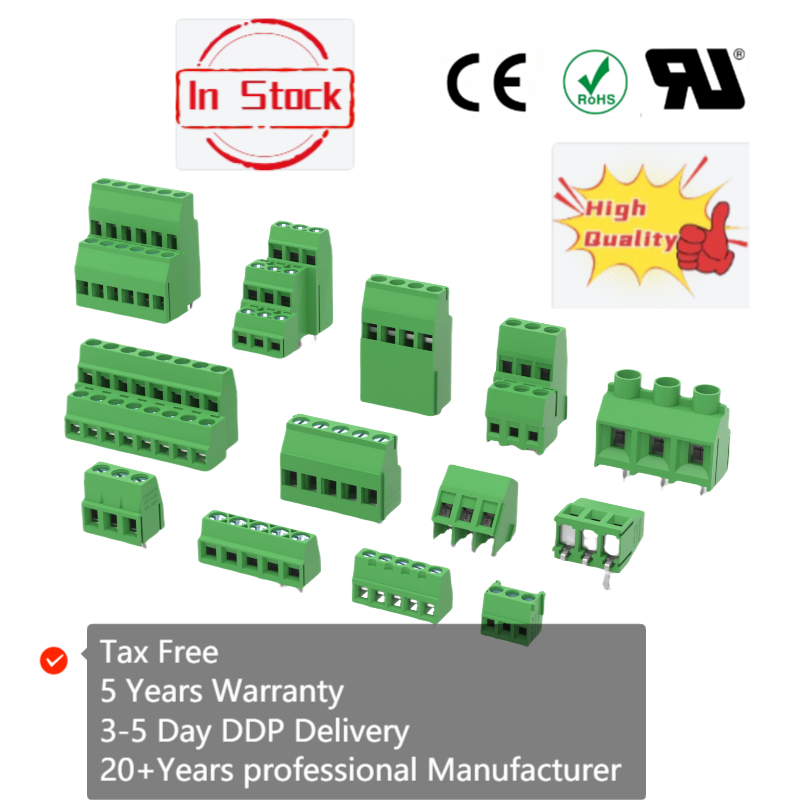
Use when: Mixed wire types, frequent rework, budget-sensitive general control. See our KF300-5.0 / DG300-5.0 screw PCB terminal blocks.
Spring / Cage-Clamp Terminal Blocks
Pros: Constant spring force resists vibration; reusable; accepts stranded wire well; compact.
Cons: Needs a screwdriver to open the clamp; slightly higher cost than screw.
Use when: DIN-rail control cabinets, transport, machinery with vibration. See our 262-301 cage clamp and 260 series cage clamp blocks.
Push-in Terminal Blocks
Pros: Fastest wiring – just insert solid or ferruled wire; very compact; consistent contact force.
Cons: Fine-stranded wire without ferrule may not seat reliably; spring has a finite cycle life; often higher unit cost.
Use when: High-volume, repetitive wiring of pre-ferruled or solid conductors (e.g. appliance, OEM module assembly). See our CH1/CH2/CH3 push-in quick terminal blocks.
How to Choose – Quick Decision
1. Vibration-heavy / railway / machine? Use Spring or Push-in.
2. Mixed or unknown wire, lots of rework? Use Screw.
3. Mass production, same wire type, speed critical? Use Push-in.
4. Need max density on the rail? Use Push-in or Spring.
FAQ
Q: Can I mix technologies in one panel? Yes – many panels use screw for power feeds and push-in/spring for signal wiring. Just keep each circuit’s rating valid.
Q: Is push-in reliable for stranded wire? Use a ferrule on fine-stranded wire; solid or ferruled wires seat most reliably.
Not sure which fits your design? Send your wiring spec to our team (https://goodelectric.net/contact-us/) and we’ll recommend a match.