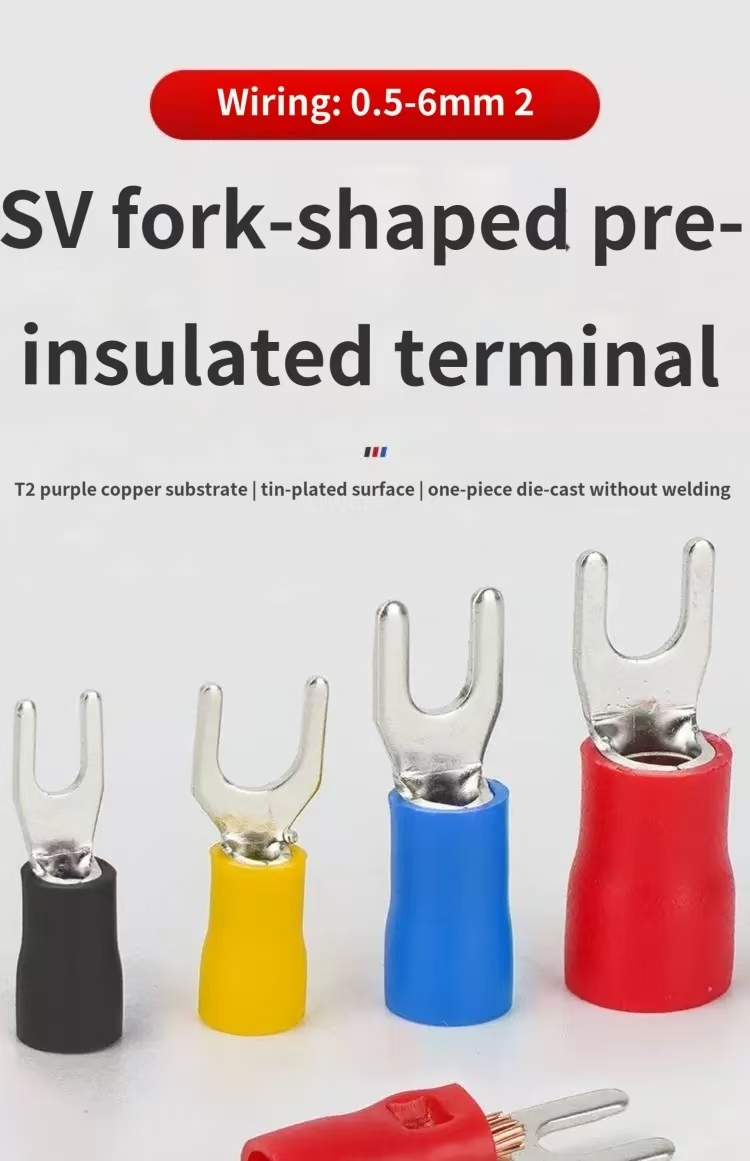
The short answer: SV fork-shaped (spade-type) pre-insulated terminals are one-piece crimp connectors made of T2 purple copper with a tin-plated surface and a flame-retardant PVC sleeve. They cover a wire range of 0.5–6 mm², are color-coded by size (black, yellow, blue, red), and are the fastest way to land a wire on a screw terminal — you get fork-style contact with the speed of a pre-insulated crimp.
As a cold-pressed copper terminal manufacturer, we produce SV series fork terminals in-house with one-piece die-cast tooling — no welded seams, no plating on joints that can crack. This guide covers the construction, color code, crimping procedure and typical applications, so your purchasing and engineering teams can specify the right size the first time.
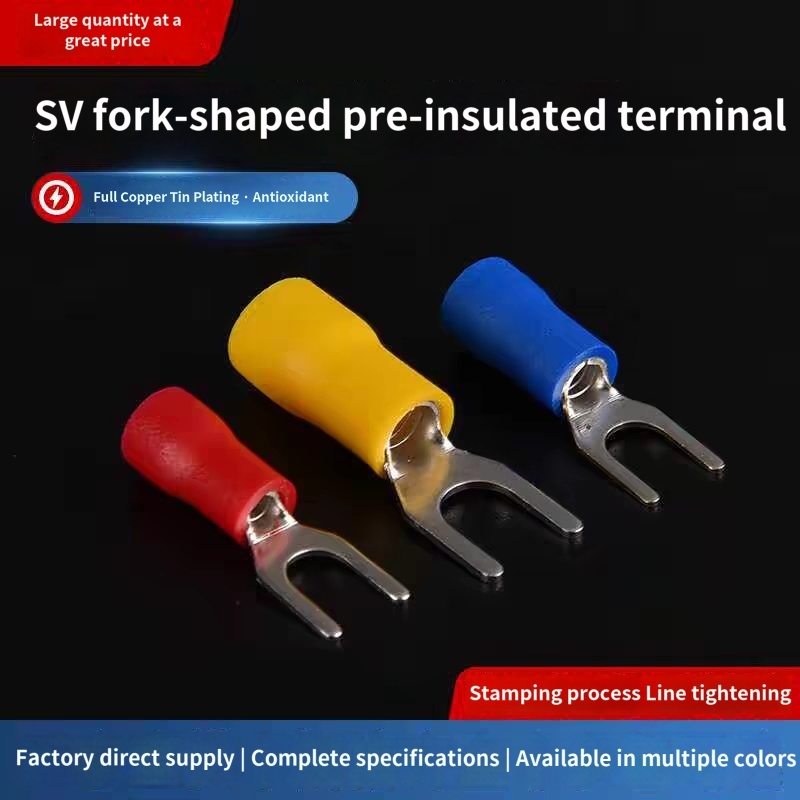
What Is an SV Fork-Shaped Pre-Insulated Terminal?
An SV fork terminal combines two things in one part:
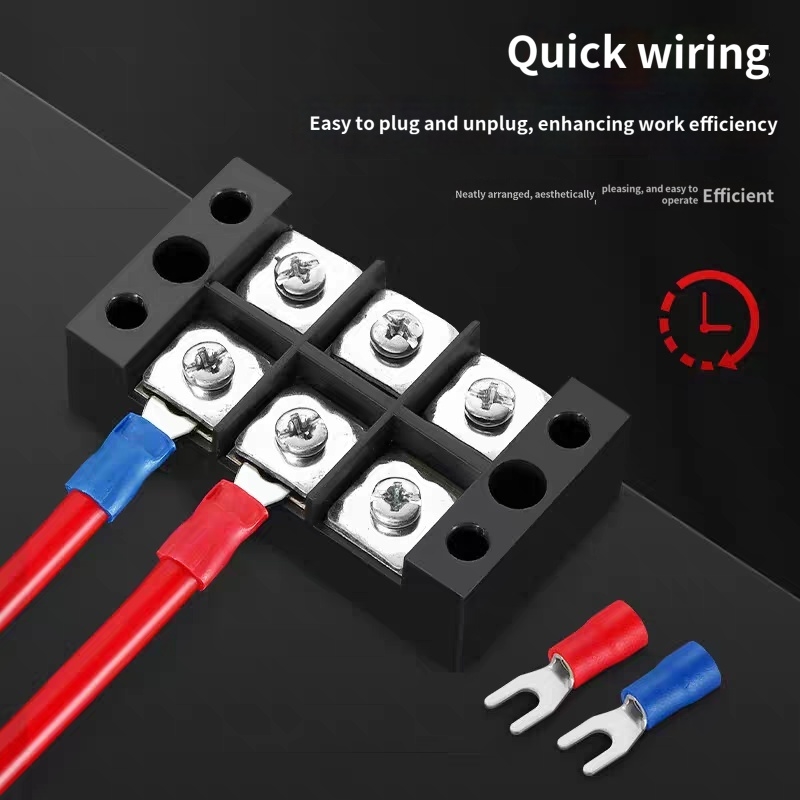
- A fork (spade) metal tongue — slides under a screw clamp without fully removing the screw, unlike a ring terminal. Ideal for barrier strips and panel-mounted screw blocks where speed matters.
- A pre-insulated PVC barrel — color-coded by wire size, with a tapered entry that guides stranded wire into the barrel and insulates the joint after crimping.
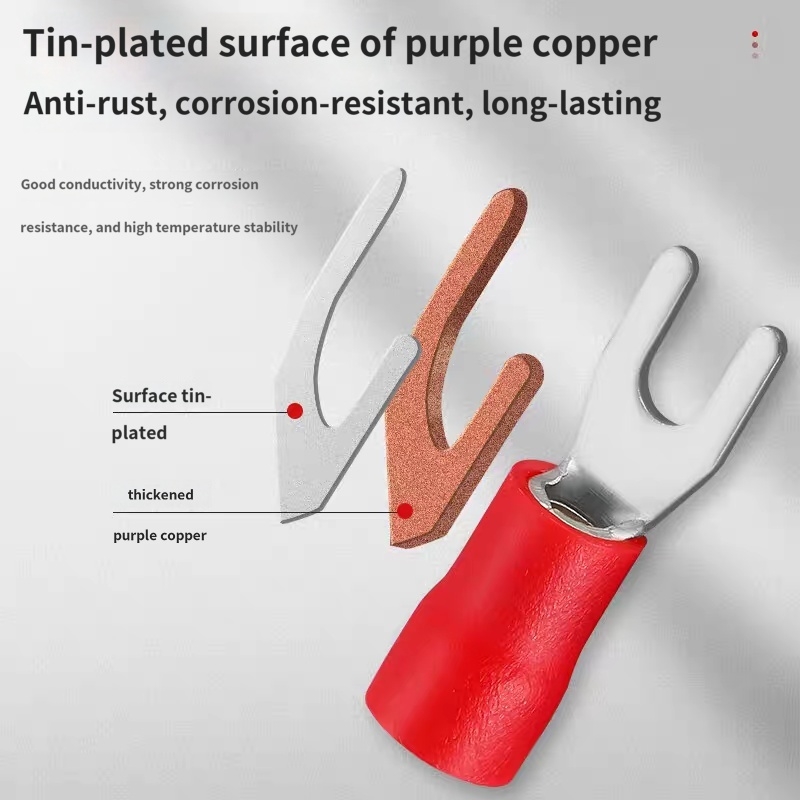
The metal tongue is die-cast in one piece from T2 purple copper (no welding), then the surface is tin-plated. The barrel is over-molded with PVC insulation. That is the whole part — which is exactly why it is cheap, fast to install and hard to get wrong.
Key Features: Copper Core, Tin Plating, One-Piece Die-Cast
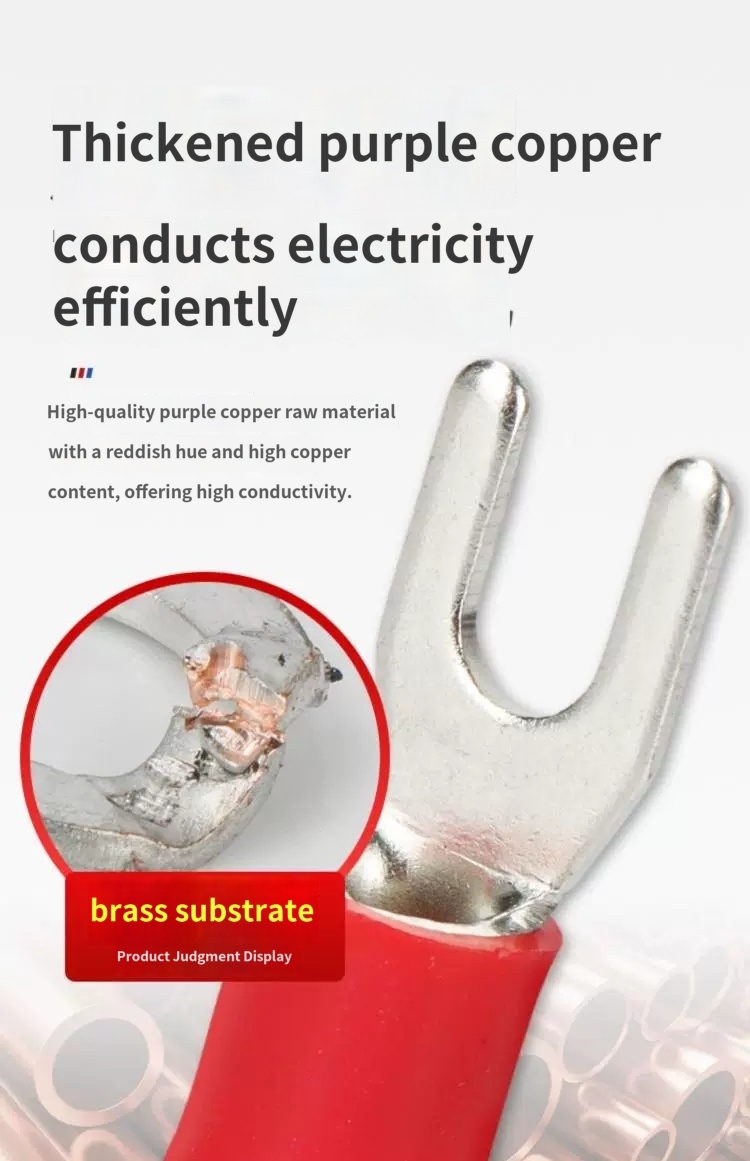
1. Thickened T2 purple copper conducts efficiently
The substrate is high-purity T2 purple copper with a reddish hue and high copper content. Compared with brass alternatives (common in low-cost imports), purple copper offers noticeably higher conductivity and better ductility during crimping — the barrel deforms evenly instead of cracking.
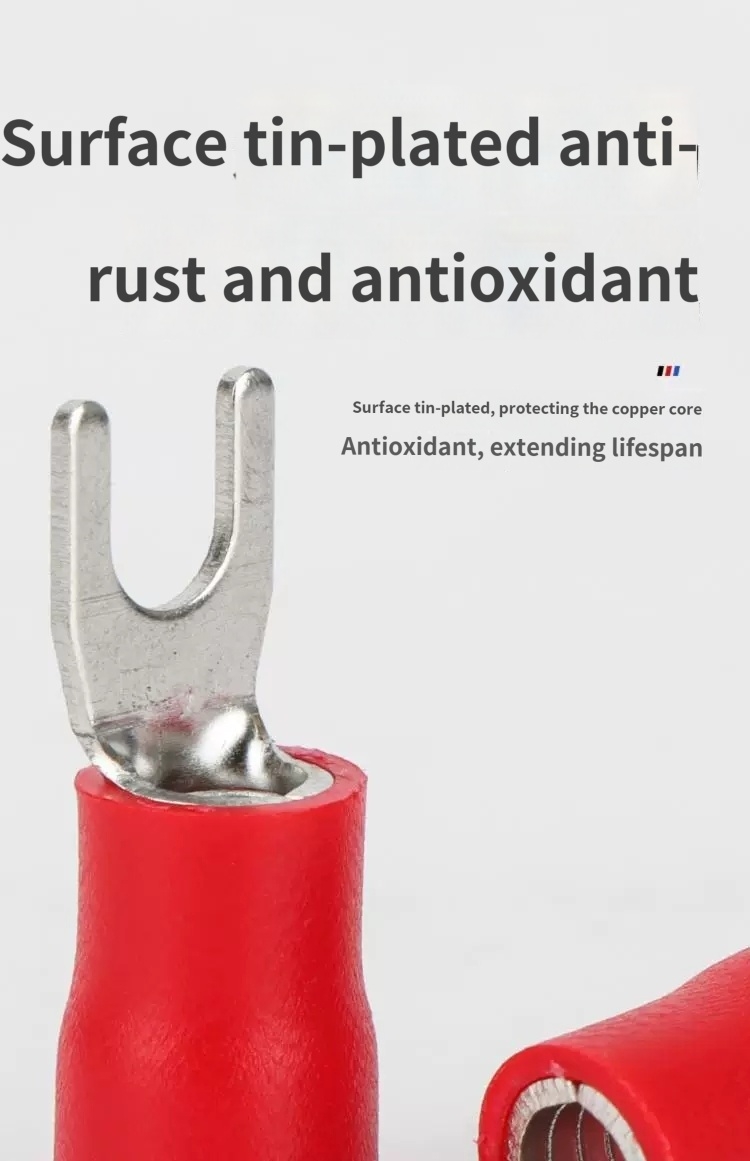
2. Tin-plated surface: anti-rust, anti-oxidant
The inner layer is full copper; the outer layer is tin-plated. This two-layer structure does two jobs:
- Copper core — high load capacity, low resistivity, stable and reliable wiring.
- Tin outer layer — forms a protective film that prevents the copper from turning green (copper oxidation) during long-term exposure to air, keeping contact resistance low over the product’s life.
3. One-piece die-cast, no welded joints
Welded fork tongues can crack at the seam under vibration or heavy crimping force. Our SV terminals are stamped and die-cast in one piece — the tongue and barrel are a single continuous copper part, stamped with line-tightening ribs for a secure crimp.
Wire Range and Color Code (0.5–6 mm²)
SV fork terminals follow the standard insulated-terminal color code. Four sleeve colors cover the full 0.5–6 mm² range:
| Sleeve color | Series | Wire range | AWG | Max current | Sleeve thickness |
|---|---|---|---|---|---|
| Red | SV 1.25 | 0.5–1.5 mm² | 22–16 | 19 A | 0.75 mm |
| Blue | SV 2 | 1.5–2.5 mm² | 16–14 | 27 A | 0.8 mm |
| Black | SV 3.5 | 2.5–4 mm² | 14–12 | 37 A | 1.0 mm |
| Yellow | SV 5.5 | 4–6 mm² | 12–10 | 48 A | 1.0 mm |
Beyond the standard four colors, the SV range extends to three large-barrel series for heavier wire and bigger studs: SV 8 (red sleeve, 2.5–4 mm², 37 A), SV 14 (blue sleeve, 4–6 mm², 48 A) and SV 22 (yellow sleeve, 2.5–4 mm², 37 A, extra-long barrel). Stud-hole diameters run from 1.7 mm up to 8.0 mm, covering screw sizes from #4 (M3) to 5/16 (M8).
SV series model quick reference
| Series | Color | Wire range | Stud sizes (USA screw) | Barrel ID φD | Insulation |
|---|---|---|---|---|---|
| SV 1.25-3 ~ 1.25-8 | Red | 0.5–1.5 mm² | #4 – 5/16 | 4.3 mm | PVC |
| SV 2-3 ~ 2-8 | Blue | 1.5–2.5 mm² | #4 – 5/16 | 4.8 mm | PVC |
| SV 3.5-3 ~ 3.5-6 | Black | 2.5–4 mm² | #4 – #10 | 6.0 mm | PVC / nylon |
| SV 5.5-3.5S ~ 5.5-8 | Yellow | 4–6 mm² | #8 – 5/16 | 6.3 mm | PVC / nylon |
| SV 8-4 ~ 8-8 | Red | 2.5–4 mm² | #8 – 5/16 | 8.3 mm | PVC |
| SV 14-6 / 14-8 | Blue | 4–6 mm² | 1/4 – 5/16 | 10.5 mm | PVC |
| SV 22-8 | Yellow | 2.5–4 mm² | 5/16 | 13.0 mm | PVC |
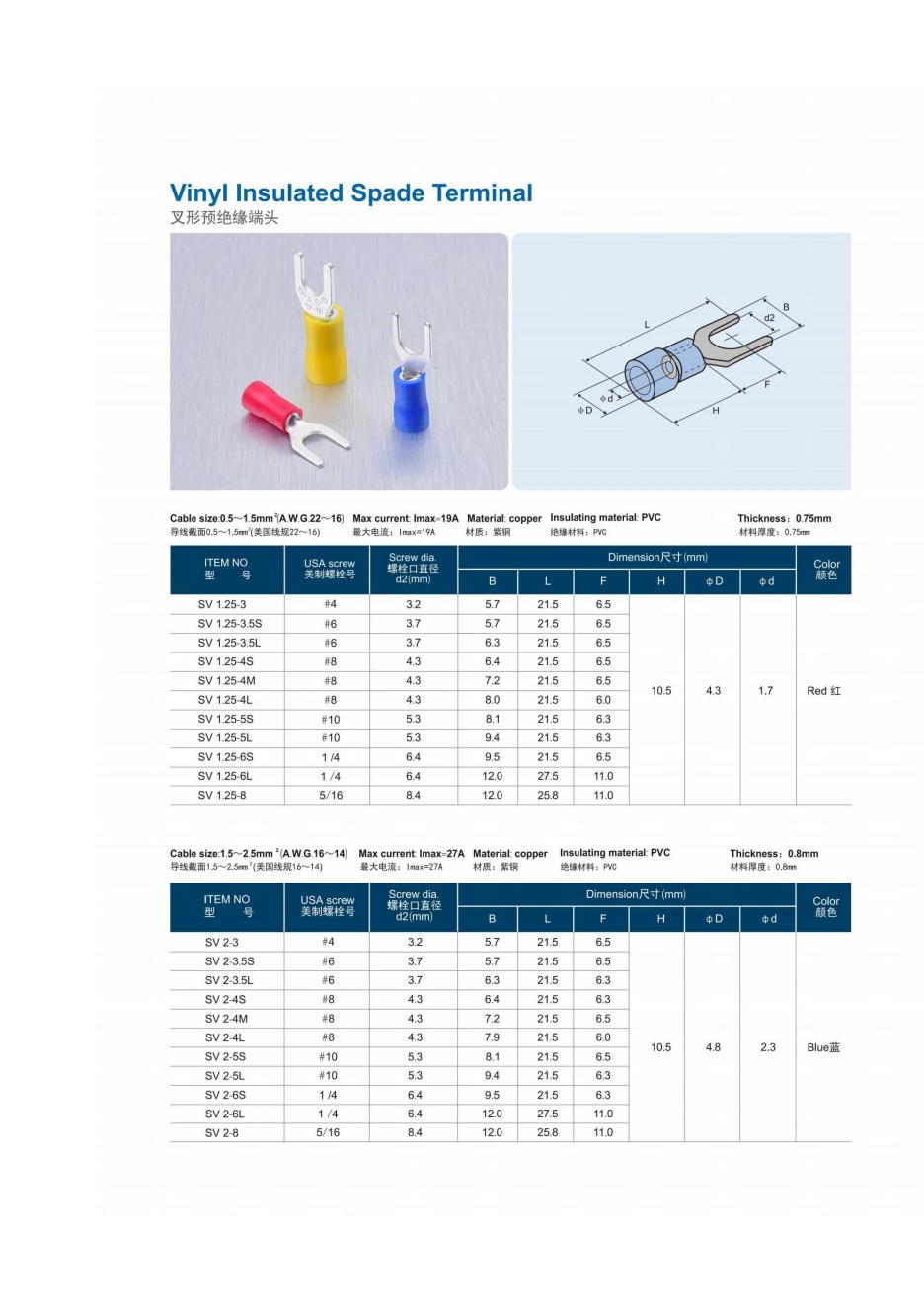
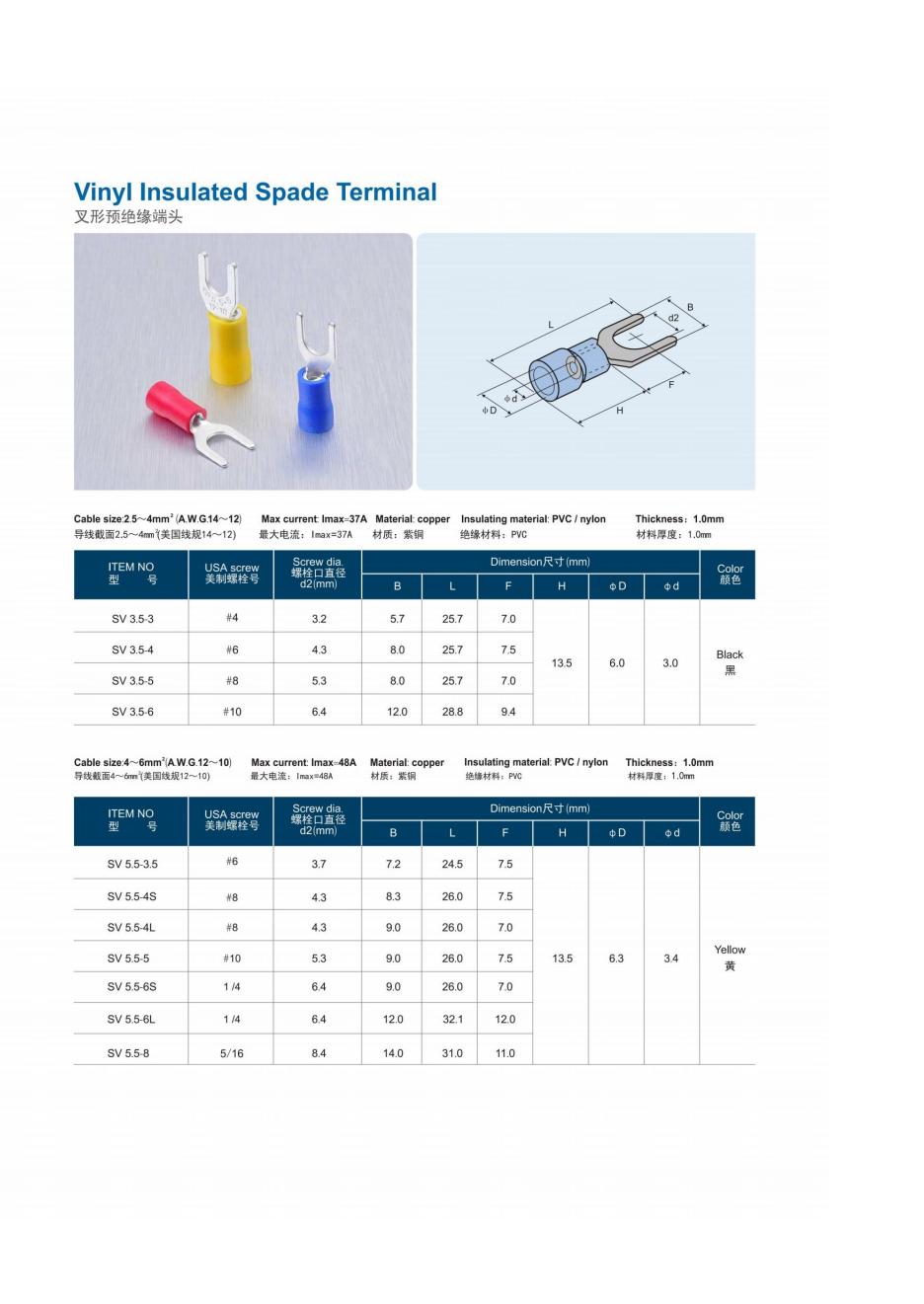
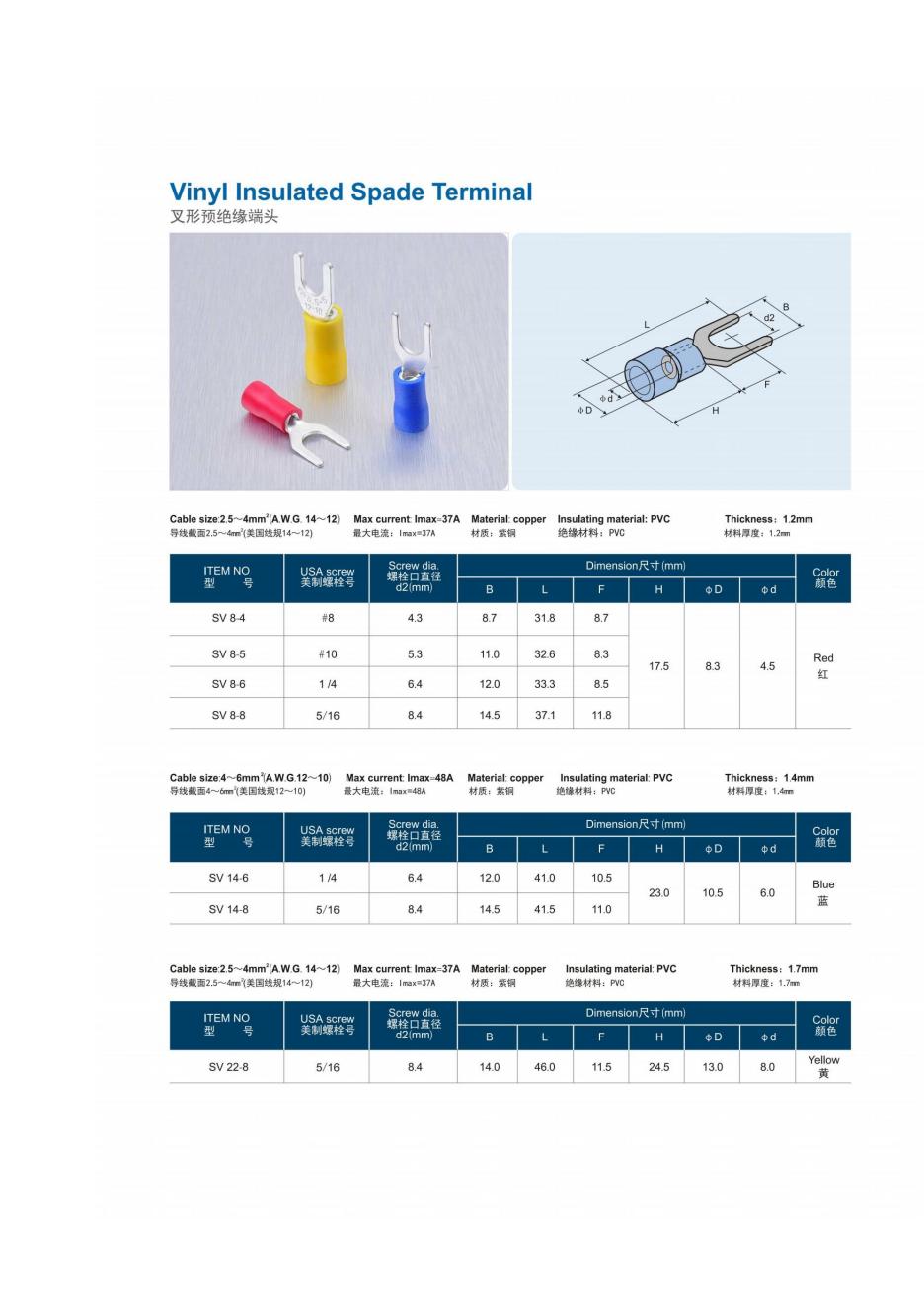
Each model number encodes the stud size — for example, SV 1.25-4 fits an #4 (M3) stud with a 4.3 mm barrel. Request our full SV series datasheet with complete B / L / F / H dimensions — samples are free.
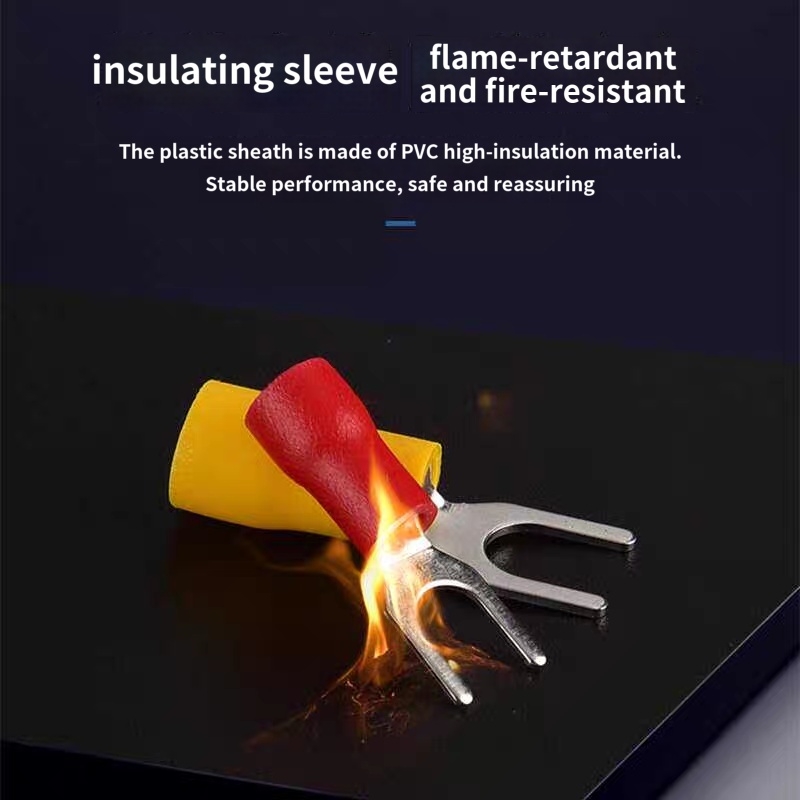
Flame-Retardant PVC Insulation Sleeve
The plastic sheath is made of high-insulation PVC with stable flame-retardant performance. In a burn test, the sleeve self-extinguishes instead of propagating flame — a detail that matters in control cabinets, household appliances and any enclosure where a loose connection could arc.
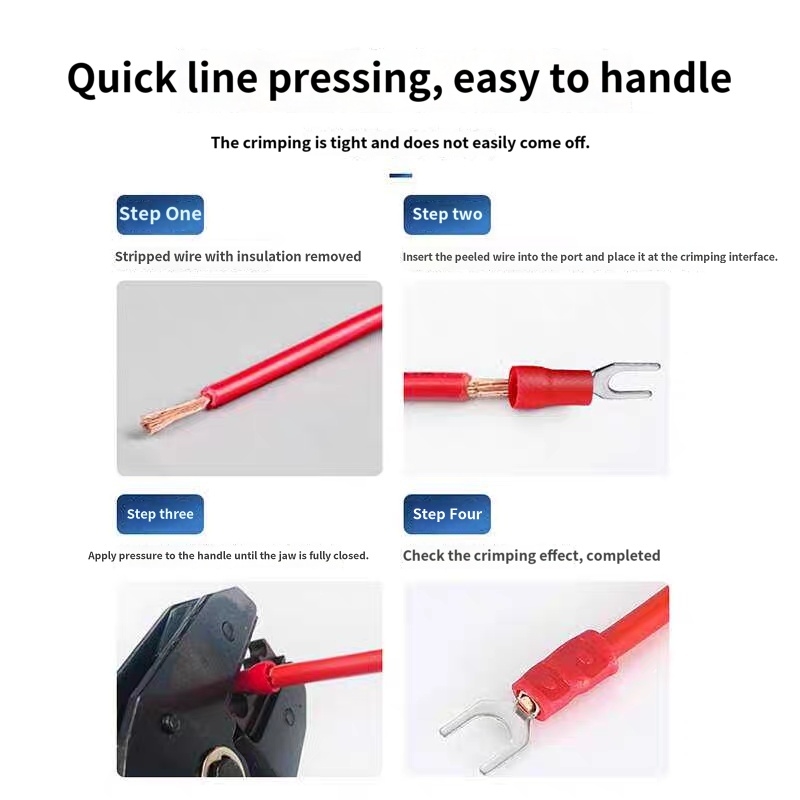
How to Crimp an SV Fork Terminal (4 Steps)
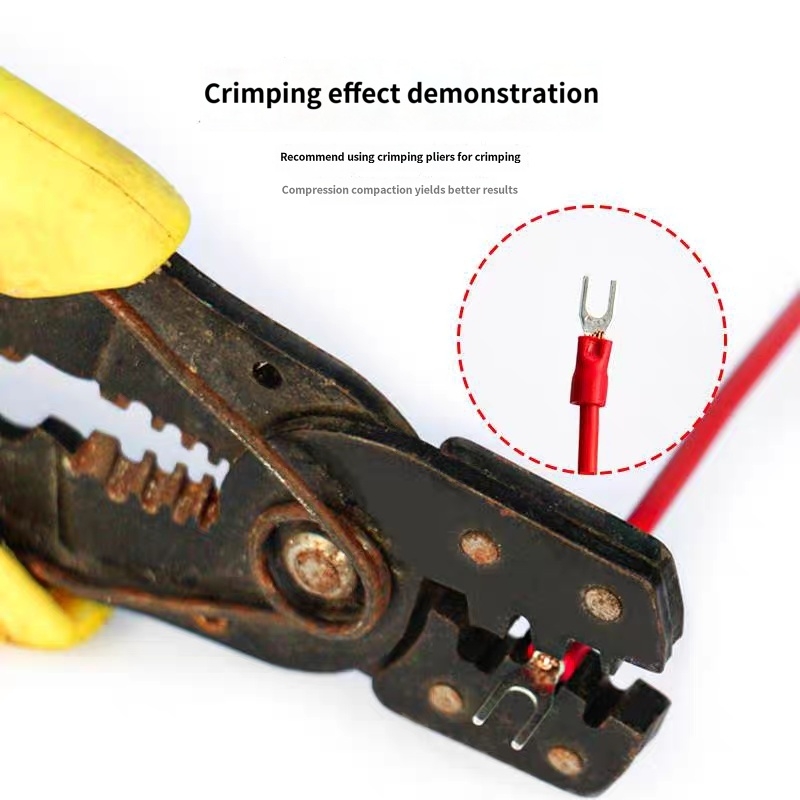
Recommended tool: a ratcheting crimping pliers. Compression compaction yields better results than hammer or plier crimps — the ratchet releases only when the correct pressure is reached, giving a gas-tight joint every time.
- Step One — Strip the wire, removing just enough insulation to fit the barrel length.
- Step Two — Insert the peeled wire into the barrel until it bottoms out at the crimp interface.
- Step Three — Apply pressure to the crimping tool handle until the jaw is fully closed (ratchet releases).
- Step Four — Check the crimp: the sleeve should be uniformly compressed, the wire should not pull out by hand. Done.
Typical Applications
SV fork terminals are the standard choice wherever a stranded wire meets a screw clamp and you want tool-free loosening later:
- Barrier terminal blocks — the fork tongue slides under the clamp plate without removing the screw, so a whole strip can be wired in minutes. See our barrier feed-through terminal strip guide for matching blocks.
- Household appliance wiring — washing machines, fans, HVAC internal harnesses.
- Power distribution panels — quick landing of control wires on screw terminals.
- Automotive and marine low-voltage harnesses — where vibration makes a re-tightenable fork preferable to a permanent joint.
Why Source SV Fork Terminals from Good Electric
- Factory direct supply — complete specifications, available in multiple colors, large quantity at a great price.
- In-house manufacturing — we are a cold-pressed terminal factory, not a trader. OEM & ODM supported.
- Free samples — test our quality before larger orders. No MOQ for standard products.
- Certified production — ISO 9001 / ISO 14001 systems; RoHS-compliant materials.
FAQ
What is the difference between an SV fork terminal and a ring terminal?
A ring terminal must have the fixing screw fully removed before installation; a fork (spade) terminal slides under a partially loosened screw. Fork terminals are faster to install and service; ring terminals offer higher pull-out security. For vibrating equipment, choose ring; for serviceable panels, fork wins on speed.
Can SV fork terminals be crimped with ordinary pliers?
In an emergency, yes — but we strongly recommend a ratcheting crimping pliers. Ordinary pliers produce uneven compression and a joint that can work loose over time. The ratchet mechanism guarantees full-jaw closure every cycle.
Do you supply other pre-insulated terminal shapes?
Yes. Besides SV fork types, our cold-pressed terminal lines cover ring (RV), bullet, blade, and closed-end connectors in the same 0.5–6 mm² color system — all with the same T2 copper tin-plated construction.
What is the MOQ and lead time?
No minimum order quantity for standard products. Samples ship in 2 days for stocked models; mass production lead time is 20–30 days per container. We support EXW, FOB, CNF, CIF and express delivery.
Need a quote or free samples of SV fork terminals? Email sales@goodelectric.net or WhatsApp/WeChat +86 133 5619 9918 — reply within 24 hours.
<!– ====================